Be patient toward all that is unsolved in your heart and try to love
the questions themselves like locked rooms and like books that are
written in a very foreign tongue. Do not now seek the answers, which
cannot be given you because you would not be able to live them. And
the point is, to live everything. Live the questions now. Perhaps
you will find them gradually, without noticing it, and live along some
distant day into the answer.
- Rilke
Showing posts with label poems. Show all posts
Showing posts with label poems. Show all posts
Wednesday, April 28, 2010

Tuesday, April 6, 2010
The Apple Trees at Olema
By Robert Hass
They are walking in the woods along the coast
and in a grassy meadow, wasting, they come upon
two old neglected apple trees. Moss thickened
every bough and the wood of the limbs looked rotten
but the trees were wild with blossom and a green fire
of small new leaves flickered even on the deadest branches.
Blue-eyes, poppies, a scattering of lupine
flecked the meadow, and an intricate, leopard-spotted
leaf-green flower whose name they didn't know.
Trout lily, he said; she said, adder's tongue.
She is shaken by the raw, white, backlit flaring
of the apple blossoms. He is exultant,
as if some thing he felt were verified,
and looks to her to mirror his response.
If it is afternoon, a thin moon of my own dismay
fades like a scar in the sky to the east of them.
He could be knocking wildly at a closed door
in a dream. She thinks, meanwhile, that moss
resembles seaweed drying lightly on a dock.
Torn flesh, it was the repetitive torn flesh
of appetite in the cold white blossoms
that had startled her. Now they seem tender
and where she was repelled she takes the measure
of the trees and lets them in. But he no longer
has the apple trees. This is as sad or happy
as the tide, going out or coming in, at sunset.
The light catching in the spray that spumes up
on the reef is the color of the lesser finch
they notice now flashing dull gold in the light
above the field. They admire the bird together,
it draws them closer, and they start to walk again.
A small boy wanders corridors of a hotel that way.
Behind one door, a maid. Behind another one, a man
in striped pajamas shaving. He holds the number
of his room close to the center of his mind
gravely and delicately, as if it were the key,
and then he wanders among strangers all he wants.
Monday, April 5, 2010
Tuesday, March 16, 2010
Touch-and-Go
by Sylvia Plath
Sing praise for statuary:
For those anchored attitudes
And staunch stone eyes that stare
Through lichen-lid and passing bird-foot
At some steadfast mark
Beyond the inconstant green
Gallop and flick of light
Gallop and flick of light
In this precarious park
Where vivid children twirl
Like colored tops through time
Nor stop to understand
How all their play is touch-and-go:
But, Go! they cry, and the swing
Arcs up to the tall tree tip;
Go! and the merry-go-round
Hauls them round with it.
And I, like the children, caught
In the mortal active verb,
Let my transient eye break a tear
For each quick, flaring game
Of child, leaf and cloud,
While on this same fugue, unmoved,
Those stonier eyes look,
Safe-socketed in rock.
Tuesday, March 9, 2010
Atlas
by Lucile Clifton
I am used to the heft of it
sitting against my rib,
used to the ridges of forest,
used to the way my thumb
slips into the sea as I pull
it tight. Something is sweet
in the thick odor of flesh
burning and sweating and bearing young.
I have learned to carry it
the way a poor man learns
to carry everything.
Wednesday, February 10, 2010
from Jamie
Ways of Talking
by Ha Jin
We used to like talking about grief
Our journals and letters were packed
with losses, complaints, and sorrows.
Even if there was no grief
we wouldn't stop lamenting
as though longing for the charm
of a distressed face.
Then we couldn't help expressing grief
So many things descended without warning:
labor wasted, loves lost, houses gone,
marriages broken, friends estranged,
ambitions worn away by immediate needs.
Words lined up in our throats
for a good whining.
Grief seemed like an endless river--
the only immortal flow of life.
After losing a land and then giving up a tongue,
we stopped talking of grief
Smiles began to brighten our faces.
We laugh a lot, at our own mess.
Things become beautiful,
even hailstones in the strawberry fields.
Tuesday, February 9, 2010
the key to this girl's heart
Peonies
By Mary Oliver
This morning the green fists of the peonies are getting ready
to break my heart
as the sun rises,
as the sun strokes them with his old, buttery fingers
and they open ---
pools of lace,
white and pink ---
and all the day the black ants climb over them,
boring their deep and mysterious holes
into the curls,
craving the sweet sap,
taking it away
to their dark, underground cities ---
and all day
under the shifty wind,
as in a dance to the great wedding,
the flowers bend their bright bodies,
and tip their fragrance to the air,
and rise,
their red stems holding
all that dampness and recklessness
gladly and lightly,
and there it is again ---
beauty the brave, the exemplary,
blazing open.
Do you love this world?
Do you cherish your humble and silky life?
Do you adore the green grass, with its terror beneath?
Do you also hurry, half-dressed and barefoot, into the garden,
and softly,
and exclaiming of their dearness,
fill your arms with the white and pink flowers
with their honeyed heaviness, their lush trembling,
their eagerness
to be wild and perfect for a moment, before they are
nothing, forever?
 (here)
Monday, February 8, 2010
reading aloud is under-appreciated
I'd like to have a book club. Headquartered here: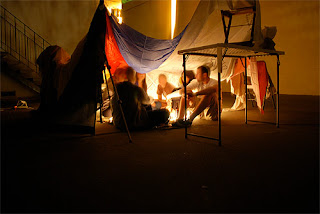
 We don't have to dissect or analyze all that much. Mostly take turns reading aloud. People from anywhere or anywhen with anythought will be welcomed and embraced.

Or here:
 We don't have to dissect or analyze all that much. Mostly take turns reading aloud. People from anywhere or anywhen with anythought will be welcomed and embraced.
Wednesday, January 20, 2010
clearly I like poetry
Facing west from California's shores,
Inquiring, tireless, seeking what is yet unfound,
I, a child, very old, over waves, towards the house of maternity,
the land of migrations, look afar,
Look off the shores of my Western sea, the circle almost circled;
For starting westward from Hindustan, from the vales of Kashmere,
From Asia, from the north, from the God, the sage, and the hero,
From the south, from the flowery peninsulas and the spice islands,
Long having wander'd since, round the earth having wander'd,
Now I face home again, very pleas'd and joyous,
(But where is what I started for so long ago?
And why is it yet unfound?)
Walt Whitman, Facing West from California's Shores
(via Anna)
Tuesday, January 19, 2010
questions persist no matter where you go
Maybe I should have been brave enough to go abroad like I had planned/imagined/hoped. Or maybe not.
By Elizabeth Bishop
There are too many waterfalls here; the crowded streams
hurry too rapidly down to the sea,
and the pressure of so many clouds on the mountaintops
makes them spill over the sides in soft slow-motion,
--For if those streaks, those mile-long, shiny, tearstains,
aren't waterfalls yet,
in a quick age or so, as ages go here,
they probably will be.
But if the streams and clouds keep travelling, travelling,
the mountains look like the hulls of capsized ships,
slime-hung and barnacled.
Think of the long trip home.
Should we have stayed at home and thought of here?
Where should we be today?
Is is right to be watching strangers in a play
in this strangest of theatres?
What childishness is it that while there's a breath of life
in our bodies, we are determined to rush
to see the sun the other way around?
The tiniest green hummingbird in the world?
To stare at some inexplicable old stonework,
inexplicable and impenetrable,
at any view,
instantly seen and always, always delightful?
Oh, must we dream or dreams
and have them, too?
And have we room
for one more folded sunset, still quite warm?
But surely it would have been a pity
not to have seen the trees along this road,
really exaggerated in their beauty,
not to have seen them gesturing
like noble pantomimists, robed in pink.
--Not to have had to stop for gas and heard
the sad, two-noted, wooden tune
of disparate wooden clogs
carelessly clacking over
a grease-stained filling-station floor.
(In another country the clogs would all be tested.
Each pair there would have identical pitch.)
--A pity not to have heard
the other, less primitive music of the fat brown bird
who sings above the broken gasoline pump
in a bamboo church of Jesuit baroque:
three towers, five silver crosses.
--Yes, a pity not to have pondered,
blurr'dly and inconclusively,
on what connection can exist for centuries
between the crudest wooden footwear
and, careful and finicky,
the whittled fantasies of wooden cages.
--And never to have had to listen to rain
so much like politicians' speeches:
two hours of unrelenting oratory
and then a sudden golden silence
in which the traveller takes a notebook, writes:
"Is it lack of imagination that makes us come
to imagined places, not just stay at home?
Or could Pascal have been not entirely right
about just sitting quietly in one's room?
Continent, city, country, society:
the choice is never wide and never free.
And here, or there...No. Should we have stayed at home,
wherever that may be?"
Friday, January 15, 2010
The Departure of the Prodigal Son
Rainer Maria Rilke
Now to go away from all this tangledness
that is part of us and yet not ours,
that like the water in old wells
reflects us trembling and ruins the image;
from all this, which as if with thorns
still clings to us--to go away,
and on this and this, so near at hand,
which almost from the first you ceased to see
(they were so common, so undemanding),
suddenly to gaze: tenderly, full of amends,
as if in a beginning and from up close:
and to see at last how without least malice,
how over everyone indifferently the hurt descends
that filled childhood to the brim--:
and then still to go, hand leaving hand,
as if you were tearing open a new-healed wound,
and to go away: where? Into certainty,
far into some unrelated warm land
that behind all action keeps its distance
like a backdrop--garden or wall;
and to go away: why? From urge, from instinct,
from impatience, from dark expectation,
from not understanding and not being understood:
To take all this upon yourself and in vain
perhaps let fall things firmly held,
in order to die alone, not knowing why--
Is this how new life begins?
Subscribe to:
Posts (Atom)
